Table of Contents
- What Is MLOps? Architecture, MLOps vs DevOps, and LLMOps
- What Is MLOps?
- Why MLOps Matters for Production Machine Learning
- Core Principles of MLOps
- MLOps vs DevOps: Key Lifecycle Differences
- MLOps Architecture: How It All Fits Together
- MLOps Maturity Levels
- MLOps Tools for Data, Training, Deployment, and Monitoring
- What Is LLMOps? Operations for Large Language Models
- LLMOps vs MLOps: Key Differences
- Linux Basics for MLOps
- Summary
What Is MLOps? Architecture, MLOps vs DevOps, and LLMOps
In this lesson, you will learn what MLOps is and why it is essential for scaling machine learning systems. We will explore how MLOps extends DevOps to manage not just code, but also data, models, and experiments, and compare the DevOps and MLOps lifecycles.
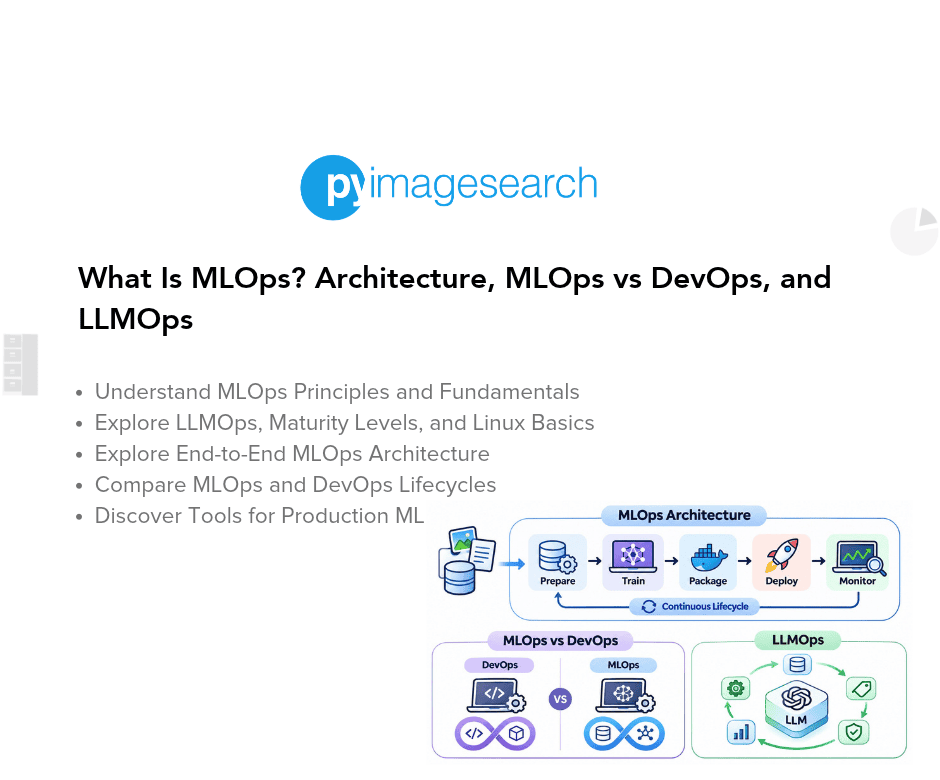
You will also get a high-level view of MLOps architecture, see how teams progress through maturity levels, and cover the MLOps tooling landscape from foundations to serving, deployment, and cloud platforms.
Along the way, we will include a short Linux basics primer (most modern MLOps/MLflow workflows run on Linux) to prepare readers for hands-on work in future lessons.
Finally, we will touch on LLMOps to understand what it is, how it relates to MLOps, and why it is becoming critical in the era of large language models.
This lesson is the 1st in a 3-part series on Machine Learning Operations (MLOps):
- What Is MLOps? Architecture, MLOps vs DevOps, and LLMOps (this tutorial)
- Lesson 2
- Lesson 3
To learn how to apply MLOps, including what it is, how it differs from DevOps, and where concepts such as MLOps architecture and LLMOps fit in, just keep reading.

What Is MLOps?
At its core, MLOps (Machine Learning Operations) extends DevOps principles to the world of machine learning (ML). If DevOps is about managing the software lifecycle (from code to deployment), then MLOps is about managing the entire ML lifecycle: code, data, models, and experiments.
The key difference lies in what gets released. In traditional software, once you ship a binary, it stays the same until developers update the code. In machine learning, models are living artifacts. Their performance degrades as data distributions shift, and they require ongoing retraining or fine-tuning to stay useful.
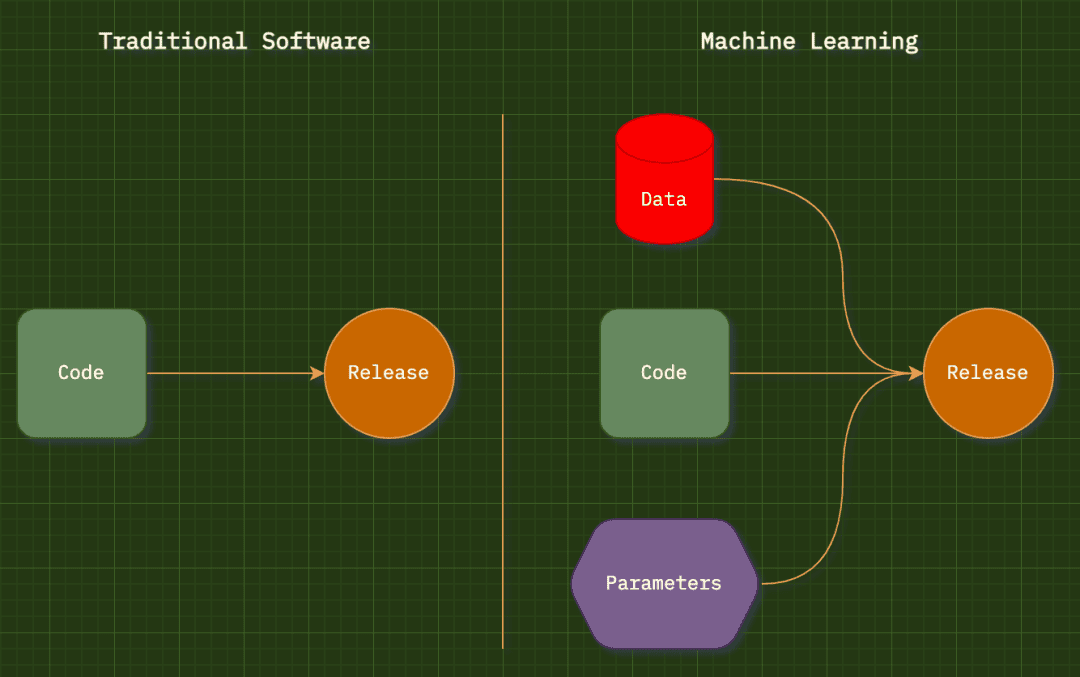
But it is not just about the release. In ML systems, all 3 components (code, data, and models) evolve together.
- New data arrives and may require relabeling.
- Models must be retrained or replaced to keep up.
- Code (algorithms, preprocessing, and infrastructure) adapts alongside them.
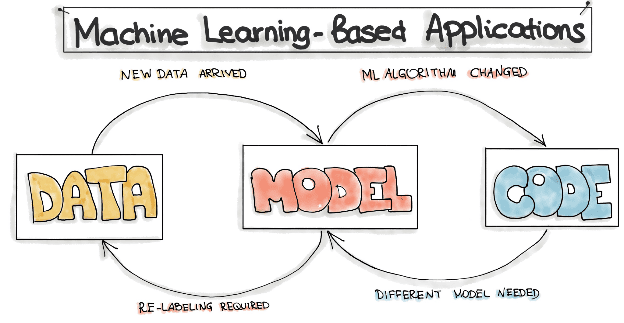
This makes MLOps far more than just “DevOps + ML.” It is a discipline designed to:
- Version and track not only code, but also datasets and models.
- Automate training, testing, and deployment pipelines.
- Continuously monitor for drift and trigger retraining loops.
- Ensure reproducibility across experiments and environments.
In short, MLOps is the glue that connects research notebooks to production systems. It helps turn fragile prototypes into reliable, scalable, and maintainable applications.
Why MLOps Matters for Production Machine Learning
It is easy to underestimate the gap between a great model in a Jupyter notebook and a robust system in production. Without MLOps, most teams hit the same pain points over and over:
- “It works on my machine” syndrome: Running the same code on another machine gives different results because the data, libraries, or environment are not identical.
- Model decay: Accuracy steadily drops after deployment as real-world data drifts away from training data.
- Data chaos: No clear versioning or lineage for datasets. Teams cannot reproduce past experiments.
- Wasted effort: Without experiment tracking, teams repeat trials that were already run but never logged.
The consequences are not academic. They are expensive.
- Recommendation systems stop showing relevant items when customer behavior changes.
- Fraud detection pipelines fail to keep up with new attack patterns.
- Large language models require ongoing prompt updates and fine-tuning to remain useful.
MLOps addresses these problems head-on:
- Reproducibility: lock down code, data, and models so results can be recreated exactly.
- Reliability: models are deployed through pipelines, not copy-paste scripts.
- Scalability: teams can retrain and redeploy with automation instead of manual handoffs.
- Collaboration: data scientists, ML engineers, and DevOps teams work on a shared process.
When you adopt MLOps, models do not just “work once.” They keep working in production, evolving alongside the data they serve.
Core Principles of MLOps
MLOps is not just a set of tools. It is a set of principles that guide how machine learning systems are built, deployed, and maintained. A solid MLOps practice rests on the following 4 pillars.
1. Automation
The goal is to minimize manual handoffs. Data pipelines, training jobs, model packaging, and deployment should run automatically through continuous integration and continuous delivery (CI/CD) pipelines. Automation reduces human error and shortens the time from experiment to production.
Example: Instead of a data scientist manually exporting a trained model, a pipeline retrains nightly and deploys the new version if it meets accuracy thresholds.
2. Reproducibility
Every model should be reproducible: same code, same data, same parameters → same result. This requires versioning not just of code, but also datasets, features, and model weights.
Example: MLflow or DVC can log experiments so you can revisit the exact conditions that produced a model months later.
3. Scalability
Prototypes often run on a laptop, but production models serve millions of predictions daily. MLOps ensures systems can scale horizontally (more replicas) and vertically (more compute), while pipelines handle larger datasets seamlessly.
Example: A fraud detection model that worked for thousands of transactions now needs to score millions. Kubernetes or serverless deployment can scale it without code changes.
4. Monitoring and Governance
Models cannot be “deploy once and forget.” Monitoring ensures that accuracy, latency, and drift are tracked continuously. Governance establishes controls and documentation that support compliance (fairness, privacy, and explainability) in regulated industries.
Example: A credit scoring model must flag if predictions start showing bias toward a subgroup, triggering retraining or human review.
Together, these pillars keep ML systems reliable, accountable, and future-proof. They also map directly to the MLOps lifecycle:
- automation: powers the pipelines
- reproducibility: secures experiments
- scalability: supports deployment
- monitoring and governance: closes the loop
MLOps vs DevOps: Key Lifecycle Differences
DevOps transformed how software teams build and ship applications. The process is well-defined: build → test → deploy → monitor. Once an application is shipped, it generally behaves the same until developers update the code.
Machine learning lifecycles look similar at a distance, but they introduce critical differences:
- Data is first-class: The lifecycle does not start with “build.” It starts with data collection and preprocessing.
- Validation goes beyond tests: Instead of just running unit tests, ML workflows validate against metrics such as accuracy, precision, or F1 score.
- Models evolve: Monitoring is not just about uptime; it is about detecting drift. A healthy model may still lose accuracy as the real world changes.
- Retraining closes the loop: Unlike software, where updates are developer-driven, ML requires automatic or scheduled retraining cycles.
A side-by-side comparison makes it clear (see Figure 3).
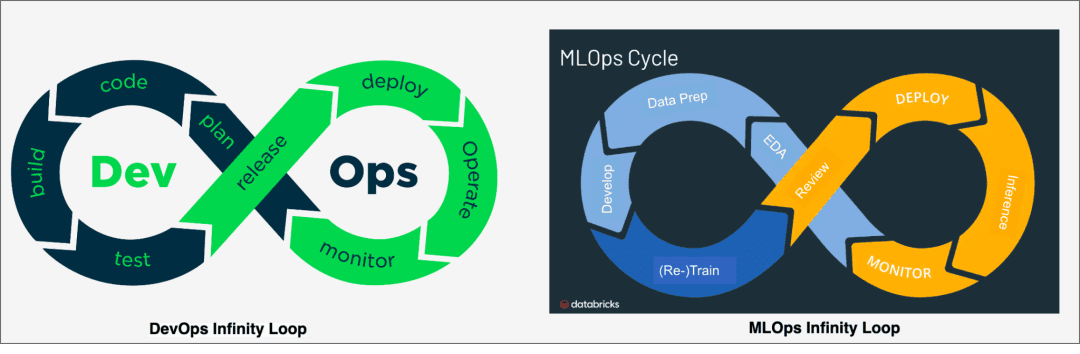
Notice how MLOps extends DevOps with additional steps for data, validation, and retraining.
The extra loops (data, validation, and retraining) are why MLOps needs its own discipline. Traditional DevOps tooling does not fully capture these dynamics.
MLOps Architecture: How It All Fits Together
MLOps is not just a collection of tools. It is an architecture that ties together the entire machine learning lifecycle. The goal is to ensure that data, models, and code move seamlessly from experimentation to production while remaining reproducible, scalable, and reliable.
At the highest level, the MLOps lifecycle can be thought of in 3 interconnected stages (see Figure 4).
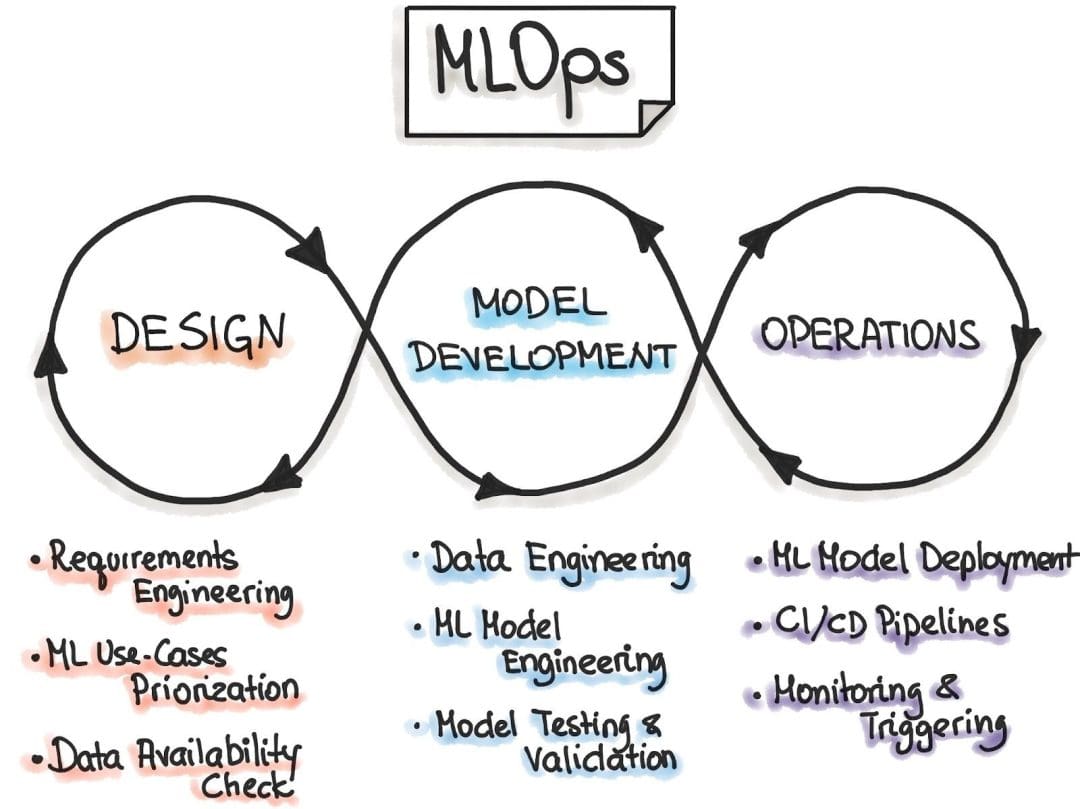
- Design: requirements engineering, use case prioritization, data availability checks
- Model Development: data engineering, model training, validation, iteration
- Operations: deployment, CI/CD pipelines, monitoring, feedback loops
While this 3-stage view captures the essence, in practice each stage is supported by multiple layers and tools. A typical MLOps architecture looks like this:
Data Layer
- Data ingestion (databases, APIs, streams)
- Storage (data lakes, warehouses)
- Versioning (DVC, lakeFS)
Experimentation and Training Layer
- Prototyping (Jupyter, Colab, scripts)
- Training pipelines (Kubeflow, Airflow, SageMaker)
- Experiment tracking and model registry (MLflow, W&B)
Deployment Layer
- Model packaging (Docker, ONNX, TorchServe)
- Serving APIs (FastAPI, Flask, KServe, Lambda)
- CI/CD pipelines for model delivery
Monitoring and Feedback Layer
- Model performance metrics (accuracy, latency, drift detection)
- Infrastructure monitoring (Prometheus, Grafana)
- Feedback loops triggering retraining
Governance and Compliance Layer
- Audit trails for data and models
- Explainability and fairness checks
- Security and access control
Together, these layers form a closed loop: data flows in, models are trained and deployed, predictions are monitored, and results feed back into retraining pipelines.
MLOps Maturity Levels
Not every team practices MLOps at the same depth. Just as DevOps adoption matures over time, MLOps also has levels of sophistication. Understanding these levels helps teams assess where they stand today and what is next on their roadmap.
Level 0: Manual and Ad Hoc
- Experiments live in notebooks or scripts on individual machines.
- Data is not versioned, and results cannot be reproduced.
- Deployment might mean copying a
.pklfile to a server. - Monitoring is manual, if it happens at all.
Risk: High chance of “it worked once, but we don’t know why.”
Level 1: Partial Automation
- Some reproducibility through version control (Git) and basic experiment tracking (e.g., MLflow).
- Pipelines exist but may be stitched together manually.
- Deployment is more structured, but retraining cycles are still irregular.
- Monitoring might check uptime, but drift detection is weak.
Benefit: Teams save time by reusing pipelines, but scaling is still painful.
Level 2: Full Automation
- End-to-end pipelines handle data ingestion, training, validation, and deployment.
- CI/CD is fully integrated, with automated testing of models.
- Drift monitoring triggers retraining loops automatically.
- Governance, audit trails, and compliance are built in.
Benefit: Models evolve smoothly with data, and the business can trust ML systems long-term.
Most organizations start at Level 0 or 1 and gradually build toward Level 2. The key is progress: every step toward automation and reproducibility reduces technical debt and unlocks scalability.
MLOps Tools for Data, Training, Deployment, and Monitoring
Talking about MLOps without mentioning tools would feel incomplete. But instead of diving deep into each one right now, let us zoom out and map the ecosystem. Think of this as a preview of what is coming in future lessons.
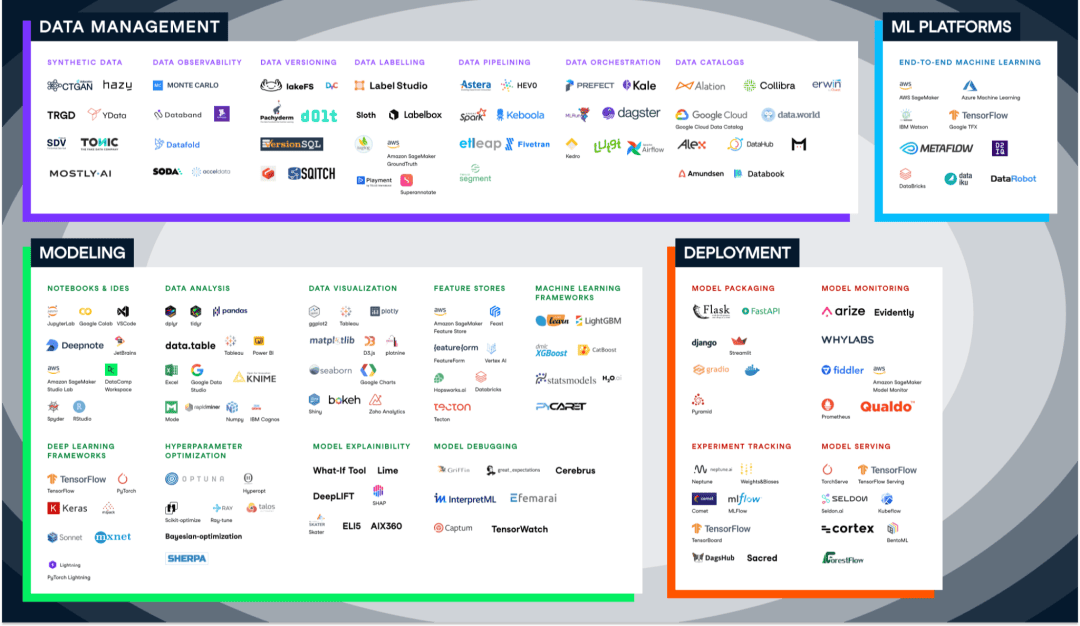
This ecosystem is huge, covering everything from managing datasets to serving models in production. To keep things practical, we will focus on a few core categories that we will explore in depth throughout the series.
Tools for Data Versioning and Experiment Tracking
- Docker: containerizes ML applications for portability.
- DVC (Data Version Control): versions datasets and pipelines.
- MLflow / Weights & Biases (W&B): experiment tracking and model registry.
Model Training Frameworks and Feature Stores
- PyTorch Lightning: structures training code for reproducibility.
- TensorFlow, PyTorch, and XGBoost: are frameworks for training deep learning and classical ML models.
- Feature Stores: manage and reuse features consistently across training and serving.
Model Serving, Deployment, and Monitoring Tools
- FastAPI: is a lightweight API for serving ML models
- TorchServe: is a production model serving framework for PyTorch
- AWS SageMaker, ECS, and Lambda: are cloud-native deployment options
- Model Monitoring: tools such as Evidently, Arize, or WhyLabs help detect accuracy and fairness issues in production
End-to-End Machine Learning Platforms
- AWS SageMaker, Azure ML, Databricks, DataRobot: are end-to-end platforms that combine data, training, deployment, and monitoring into one managed environment.
The key takeaway: no team uses everything at once. The best tools are the ones that serve your workflow. As we move through this series, we will piece these building blocks together, showing how to combine them into an end-to-end MLOps practice.
What Is LLMOps? Operations for Large Language Models
As large language models (LLMs) such as GPT (Generative Pre-trained Transformer), LLaMA, and Mistral have moved from research into production, they have introduced new operational challenges. Traditional MLOps practices still apply, but the scale, complexity, and open-ended nature of LLMs demand their own extension: LLMOps.
At a high level, LLMOps is about applying the same principles of MLOps (automation, reproducibility, scalability, and monitoring) but adapting them to the unique requirements of LLMs:
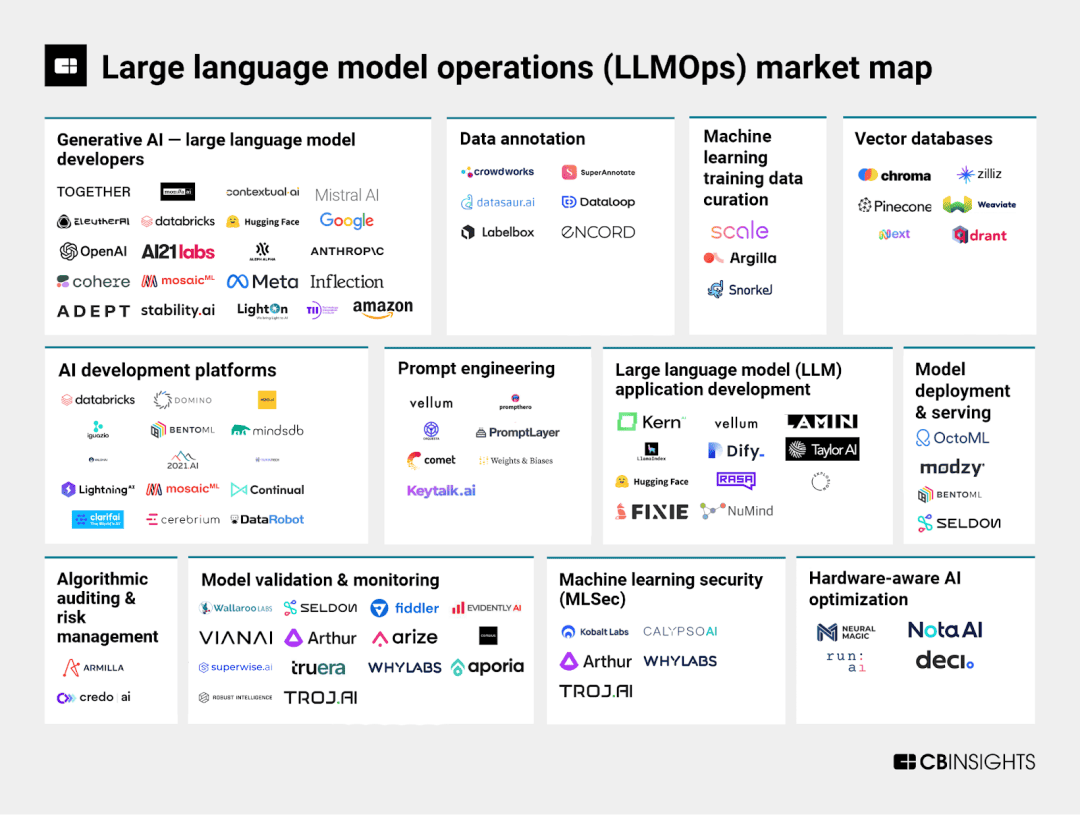
- Model Size and Serving: Unlike smaller ML models, LLMs often contain billions of parameters. Serving them requires distributed inference, quantization, or specialized GPU/TPU acceleration. Some companies even use hardware-aware optimizers (e.g., OctoML, Neural Magic) to squeeze efficiency out of large deployments.
- Continuous Adaptation: Instead of retraining from scratch, teams often fine-tune with LoRA, adapters, or parameter-efficient training methods. On top of that, prompt engineering platforms (e.g., PromptLayer, Vellum) allow non-technical teams to manage prompts as first-class artifacts.
- Retrieval-Augmented Generation (RAG): LLMs connected to external knowledge bases can stay up to date. This introduces new infrastructure needs such as vector databases (e.g., Pinecone, Weaviate, Chroma) and data curation pipelines (e.g., Scale AI, Snorkel).
- Evaluation and Safety: Unlike a classifier, which can be measured with accuracy or F1, LLMs produce open-ended text. Evaluating them requires new metrics (helpfulness, toxicity, hallucination rate), human feedback loops, and advanced monitoring/guardrails (e.g., Evidently, Arize, WhyLabs, Fiddler).
In short: LLMOps is MLOps, evolved for the LLM era. It builds on the same foundation but emphasizes scalable deployment, resource optimization, continuous adaptation, and safe usage at scale.
We will dive deeper into LLMOps in the advanced lessons of this series, where we will look at how to finetune and deploy LLMs, integrate retrieval pipelines, and set up monitoring for safety. For now, it is enough to recognize that just as MLOps became essential for productionizing ML, LLMOps is quickly becoming essential for productionizing LLMs.
LLMOps vs MLOps: Key Differences
MLOps and LLMOps share the same foundation i.e. bringing DevOps discipline to machine learning but the scale, complexity, and behavior of LLMs introduce new challenges that traditional MLOps does not fully address.
Table 1 compares MLOps and LLMOps.
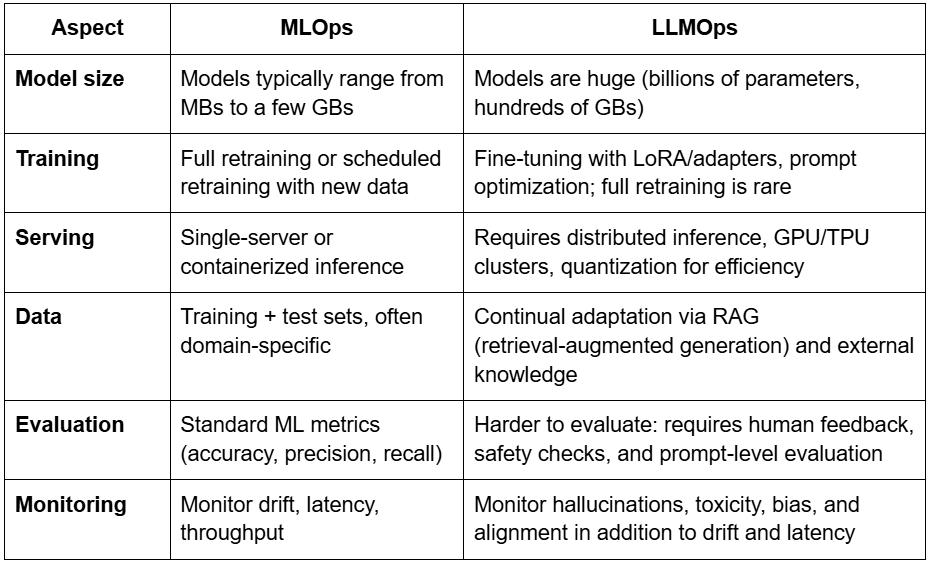
In other words, LLMOps extends MLOps by adding specialized workflows for:
- handling massive models at inference time
- updating models efficiently with lightweight fine-tuning
- managing external retrieval pipelines
- ensuring safe and aligned generation
Linux Basics for MLOps
If you are serious about MLOps, you need to be comfortable with Linux. Many ML workloads (whether it runs on a cloud VM, in a Docker container, or on a Kubernetes cluster) will run on a Linux server.
Even if you are training models on your laptop today, the moment you deploy to production, you will be SSH-ing into Linux boxes, tailing logs, and debugging file permissions. The earlier you build muscle memory, the smoother everything else becomes.
Why Linux Matters for MLOps Workflows
- Servers Run Linux: AWS EC2, GCP, and Azure all default to Linux images.
- Containers Use Linux: Docker and Kubernetes are built on Linux concepts (namespaces, cgroups).
- Automation Assumes Linux: CI/CD pipelines, shell scripts, and cron jobs live in a Linux environment.
Learning Linux is not about memorizing 200 commands. It is about knowing the 20% of commands you will use 80% of the time.
Starter Commands for Everyday Use
SSH (Secure Shell)
SSH is a protocol used to securely log onto remote systems. It is used most often in the command-line interface for Unix-like systems such as Linux. SSH provides a secure channel over an unsecured network in a client-server architecture. For instance, if you are at a computer in New York and need to manage a server located in Tokyo, you could use SSH to log into the server and run commands as if you were there in person.
Example:
ssh username@remotehost.com
The above command logs you into remotehost.com with the username username.
Vim
Vim is a highly configurable text editor built to enable efficient text editing. It is an improved version of the vi editor distributed with most UNIX systems. It has many commands and is known for its keyboard-centered operation, which lets users perform tasks efficiently without the use of a mouse.
Example:
vim filename.txt
This command opens the file filename.txt in Vim. If the file does not exist, it will be created.
htop
htop is an interactive system-monitoring tool for Unix-based systems. It provides a real-time, dynamic view of the processes running on a system. htop is much more interactive than the standard top command. It allows for scrolling vertically and horizontally to display processes and complete command lines.
Example:
htop
This command will run htop, displaying a real-time overview of system processes.
ps
The ps command in Unix and Linux is used to display information about active processes. It provides a snapshot of the current processes along with detailed information such as user identifier (ID), central processing unit (CPU) usage, memory usage, and command name.
Example:
ps -aux
The above command displays all processes from all users in a detailed format.
scp (Secure Copy)
The scp command is used to securely copy files and directories between 2 locations. Like SSH, scp uses the SSH protocol for data transfer.
Example:
scp /path/to/local/file username@remotehost:/path/to/remote/directory
The above command copies a local file to a remote directory.
rsync (Remote Sync)
rsync is a fast and versatile tool used for copying and synchronizing files both locally and remotely. rsync is great for maintaining backups and mirroring data because it only transfers the difference between source and destination.
Example:
rsync -avz /path/to/source/directory/ username@remotehost:/path/to/destination/directory/
This command syncs the contents of the source directory to the destination directory. The -avz flags enable archive mode (-a), verbose output (-v), and compression during transfer (-z).
tmux (Terminal Multiplexer)
tmux is a terminal multiplexer. It allows you to switch easily between several programs in one terminal, detach them (they keep running in the background), and reattach them to a different terminal.
Example:
tmux new -s train
This command starts a new tmux session. Within this session, you can create new windows (Ctrl+b c), switch between windows (Ctrl+b n for the next window), split windows into panes, and more.
What's next? We recommend PyImageSearch University.

120+ total classes • 115+ hours of on-demand code walkthrough videos • Last updated: November 2026
★★★★★ 4.84 (128 Ratings) • 16,000+ Students Enrolled
I strongly believe that if you had the right teacher you could master computer vision and deep learning.
Do you think learning computer vision and deep learning has to be time-consuming, overwhelming, and complicated? Or has to involve complex mathematics and equations? Or requires a degree in computer science?
That’s not the case.
All you need to master computer vision and deep learning is for someone to explain things to you in simple, intuitive terms. And that’s exactly what I do. My mission is to change education and how complex Artificial Intelligence topics are taught.
If you're serious about learning computer vision, your next stop should be PyImageSearch University, the most comprehensive computer vision, deep learning, and OpenCV course online today. Here you’ll learn how to successfully and confidently apply computer vision to your work, research, and projects. Join me in computer vision mastery.
Inside PyImageSearch University you'll find:
- ✓ 120+ courses on essential computer vision, deep learning, and OpenCV topics
- ✓ 94+ Certificates of Completion
- ✓ 115+ hours of on-demand video
- ✓ Brand new courses released regularly, ensuring you can keep up with state-of-the-art techniques
- ✓ Pre-configured Jupyter Notebooks in Google Colab
- ✓ Run all code examples in your web browser — works on Windows, macOS, and Linux (no dev environment configuration required!)
- ✓ Access to centralized code repos for all 540+ tutorials on PyImageSearch
- ✓ Easy one-click downloads for code, datasets, pre-trained models, etc.
- ✓ Access on mobile, laptop, desktop, etc.
Summary
In this lesson, we introduced MLOps and explained why it has become essential for scaling machine learning systems. We looked at how MLOps extends the principles of DevOps to manage not only code, but also the data, models, and experiments that make ML workflows unique. Along the way, we compared the DevOps and MLOps lifecycles, showing how additional practices (e.g., data validation, drift monitoring, and retraining) set MLOps apart.
We also explored the foundations of MLOps architecture, breaking it into stages and layers that connect data pipelines, training workflows, deployment systems, and monitoring. To make this practical, we discussed how teams progress through different maturity levels, from ad hoc scripts to fully automated pipelines that can retrain and redeploy models with minimal human intervention.
Another highlight was the MLOps tooling landscape. We mapped out the ecosystem from foundational tools (e.g., Docker, DVC, MLflow, and W&B) to deployment tools (e.g., FastAPI, TorchServe, and KServe) and cloud platforms (e.g., AWS SageMaker, Azure ML, and Databricks). This gave us a preview of the technologies we will dive deeper into throughout the series.
To set the stage for hands-on work, we also included a short Linux basics primer. Since most modern MLOps and MLflow workflows run on Linux, learning essential commands now ensures you will be comfortable following along in future lessons.
Finally, we touched on LLMOps, exploring what it is, how it builds on MLOps, and why it is becoming critical in the era of large language models. As LLMs introduce new challenges (e.g., distributed inference, RAG pipelines, and safety monitoring), LLMOps is emerging as the natural evolution of MLOps.
Citation Information
Singh, V. “What Is MLOps? Architecture, MLOps vs DevOps, and LLMOps,” PyImageSearch, S. Huot, A. Sharma, and P. Thakur, eds., 2026, https://pyimg.co/dqztp
@incollection{Singh_2026_mlops-architecture-mlops-devops-llmops,
  author = {Vikram Singh},
  title = {{What Is MLOps? Architecture, MLOps vs DevOps, and LLMOps}},
  booktitle = {PyImageSearch},
  editor = {Susan Huot and Aditya Sharma and Piyush Thakur},
  year = {2026},
  url = {https://pyimg.co/dqztp},
}
To download the source code to this post (and be notified when future tutorials are published here on PyImageSearch), simply enter your email address in the form below!

Download the Source Code and FREE 17-page Resource Guide
Enter your email address below to get a .zip of the code and a FREE 17-page Resource Guide on Computer Vision, OpenCV, and Deep Learning. Inside you'll find my hand-picked tutorials, books, courses, and libraries to help you master CV and DL!



Comment section
Hey, Adrian Rosebrock here, author and creator of PyImageSearch. While I love hearing from readers, a couple years ago I made the tough decision to no longer offer 1:1 help over blog post comments.
At the time I was receiving 200+ emails per day and another 100+ blog post comments. I simply did not have the time to moderate and respond to them all, and the sheer volume of requests was taking a toll on me.
Instead, my goal is to do the most good for the computer vision, deep learning, and OpenCV community at large by focusing my time on authoring high-quality blog posts, tutorials, and books/courses.
If you need help learning computer vision and deep learning, I suggest you refer to my full catalog of books and courses — they have helped tens of thousands of developers, students, and researchers just like yourself learn Computer Vision, Deep Learning, and OpenCV.
Click here to browse my full catalog.